Showing posts with label IB. Show all posts

Tuesday, December 3, 2013

Data Collection and Processing Checklist (DCP)

DCP and CE checklist

Lab report checklist for DCP & CE
  • Title of lab, your name, partners name ( if you have one) and date
  • Data table has a title
  • Data has observations
  • Data has errors and uncertainties
  • Data decimal places agree with uncertainty decimal places
  • Data processing equations given
  • Data processing calculations have subheadings are clear and easy to read
  • Processed data table has a title
  • Uncertainties have been propagated:
  • % error has been calculated
  • Graph has a title
  • Graph has axis labels, with units and uncertainties
  • Graph has best fit line if appropriate
  • The final calculated values have been presented with the correct significant figures and propagated errors
  • The conclusion has been stated and justified by referring to theory, analyse graph or measured values
  • Sources of theoretical values have been given
  • The magnitude of the propagated error has discussed as a measure of precision
  • Different repetitions  of the same experiment have been compared to give an estimate of random error
  • Percentage error has been calculated if there is one and discussed in terms of systematic error
  • All types of error have been commented on
  • All possible limitations, assumptions and errors in the lab procedure have been discussed with reference to the random (trials) and systematic error.
  • Modifications to the procedure to eliminate errors have been suggested that are not superficial

Wednesday, October 9, 2013

IB Bio Flashcards

Many students have taken the IB exams in the past.  There are many resources on the internet for studying for exams.

Here is a flash card set on Quizlet of past IB exam questions in Biology.

Check it out!

http://quizlet.com/4192752/bio-2-past-ib-questions-flash-cards/

Wednesday, April 3, 2013

Science Videos

 
This teacher has created a series of IB Biology videos that cover topics in the Biology course.  Each one is only about 2-3 minutes long. 
 
This is a great resource!
 
Here is one of the videos.  Feel free to browse.  From this you tube site, there are links to science videos in other disciplines, including Chemistry and Environmental Systems (ESS).


Wednesday, March 27, 2013

ABCs of IB (or ToK, I.A, IB, IOP, What?) aka the Alphabet Soup of IB


What do all these Acronyms MEAN?!?!?!
 
T.o.K. stands for Theory of Knowledge.  It is a class where you learn how you know what you know.  And if you know it at all.
 
 
C.A.S. stands for Creativity, Action and Service.  These are projects that the 11th and 12th graders are involved in for credit.
 
I.A. stands for Internal Assessments.  This is an assignment that is assessed by the teachers at our school.  Some may be sent out as samples. Sometimes, these may have limited teacher input.
 
E.A. is an External Assessment.  These are assignments that are graded by IB assessors.
 
I.B. is the International Baccalaureate. It is the programme of study.
 
I.O.P. Individual Oral Presentation.  This can also be an I.A. or an E.A.
 
E.E. is the Extended Essay, a 4000 word paper on the topic of the student's choice.
 
S.L. is Standard Level.
 
H.L. is Higher Level.
 
P.P.A. is a Practical Play Analysis (did you think there was only acting the Theatre class?).
 
These are only the beginning.  Want to see more? Check here and here. And this is kind of funny, here.  Once you have read all these, you can quiz yourself here


Tuesday, March 26, 2013

Fun Stuff


Fun in IB 


Stuff IB Students Say 


IB Style

Monday, March 25, 2013

O.P.V.L.

Historical Analysis in the IB can be scary!

Just remember OPVL!


"When considering OPVL for your sources of evidence, think about what type of source you are evaluating. A WWII-era fork and spoon are very different than a letter written home by a WWII soldier. Both sources are valid but you'll have to consider different questions for OPVL."
~Mr. Hyer 


Origin


– In one or two sentences state the origins of the source.
  • What type of document is it?


    • When and where was it produced?


      • Who produced it?
      Example Sentence:
       
      Template:
       
      This origin of this source is a _____________ that was written by ____________in ____________in___________.  Its purpose was to _______________ so _____________. A value of this is that it __________________. However, a limitation of the source is that it ___________________.
       
      Filled in template:
       
      The origin of the source is a letter that was written by Thomas Jefferson in 1787 in Virginia. Its purpose was to convince George Washington to veto the National Treasury so there would be no central bank. A value of this document is that it shows how the anti-Federalists were feeling about Alexander Hamilton's idea for a National Treasury. However, a limitation of the source is that it only shows Thomas Jeffereson's perspective and not the view of the other side.


      Purpose


      – In one or two sentences state the purpose of the source.
       
      The purpose of the source…


      • Who was the intended audience?


      • For what purposes was it written?
      Key Words to possibly use here:
       
      Persuade
      Inform
      Debate
      Convince
      Detail
      Outline
      Communicate
      Describe
      Entice
      Sell
      Rally


      Value


      – In one or two well-written paragraph(s) explain the value of the document for


      historians. Provide and explain specific evidence from the document to support your

      answers. A minimum of two values must be proven.
      With reference to the origin and purpose, what is the value of the document for
      historians studying this event?


      Example:
      This document is valuable because it was written ______________________ and the author was ____________________.  This shows that ____________________.


      Key Words to possibly use here:
      Bias
      Propaganda
      Written at the time of the events
      Historical Perspective
      Advertisement
      Campaign
      Letter
      Memoir
      Private Writing
      Public Writing
       
      Limitations


      – In one or two well-written paragraph(s) explain the limitations of the


      document. Remember to make specific references to the document in your response.

      A minimum of two limitations must be proven.


      With reference to the origin and purpose, what are the limitations of the
      document for historians studying this event?

      Because this document was written by _______________ in ________________, it has a limitation of ___________________.


      Key Words to possibly use here:
      Bias
      Propaganda
      Written at the time of the events
      Historical Perspective
      Advertisement
      Campaign
      Letter
      Memoir
      Private Writing
      Public Writing

       Helpful links:
      OPVL Definitions
      OPVL List of Types of Sources with Vs and Ls
      OPVL with Grading Rubric


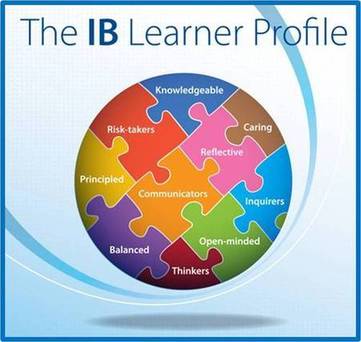
      The IB Learner Profile

      This is the IB Learner Profile developed by the International Baccalaureate


      The IB Learner Profile informs instruction in the International Baccalaureate course of study.  These 10 traits have been chosen by the IB to be important outcomes for students in the IB programme. Which do you think is the most important to you? The least?  The easiest to achieve? The hardest?
       
      As a reflective IB learner, think about these traits and check in with yourself occasionally.  Are you balanced?  Are you inquiring enough? How well are you communicating ideas in the different areas of learning? 

       
      Use these traits in reflections on C.A.S., in Theatre, in the Arts and in your regular academic classes.